A California-based startup called Savor has figured out a unique way to make a butter alternative that doesn’t involve livestock, plants, or even displacing land. Their butter is produced from synthetic fat made using carbon dioxide and hydrogen, and the best part is —- it tastes just like regular butter.
Interesting way to get fat alternatives, people are already used to eating fake butter regularly, so it probably wouldn’t take much to add this to our diet.
It’s also closer to butter than butter alternatives. It’s not made to be more healthy, just more planet friendly.
Sounds like margarine with more chances to shit myself
Margarine is made of hydrogenated oil. This is chemically identical to the fatty acids in butter. It’s not an alternative for dietary purposes, it’s just a more planet friendly solution.
actual margarine is getting hard to find in stores around here, and when you do it’s priced almost as high as a non-sale price of real butter. margarine has 80% fat content and similar baking and cooking properties as butter.
what’s on store shelves is a cheapened, watered down product laced with extra chemicals and fillers, ranging from 25-40% oil and can’t even make a proper box of mac & cheese. some of them don’t even melt when put on toast, hot, right from the toaster.
What about the trans fat byproduct from margarine production?
I think it’s closer to the coal butter synthesis but maybe they found a more efficient method using other carbon sources
Carbo-LEO.
“You see, we take all that bad stuff we learned from Oleo pantshitting technology, and then we move it around. Now we have ‘Carbo-LEO’'.”
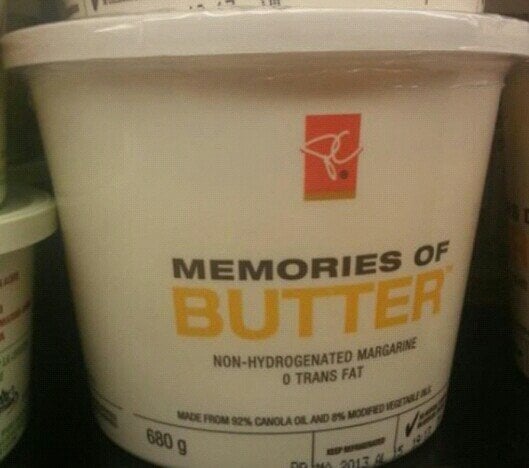
What on earth is that picture?
Canadian brand (President’s Choice) that apparently has a “memories of” product line.
Don’t want to be a hater but doesn’t this basically create fat without nutrients? It feels like this is reinventing margarine albeit in a cool way.
They’re the same fatty acids found in butter. Margarine is hydrogenated oil.
They’re from the same class yes, but is it also going to contain vitamins A, D, E and K2 or contain fatty acids like Conjugated Linoleic Acid or Butyric acid?
I’m trying to point out that factory produced fats will most likely lose out on the health benefits of butter as a source of fatty acids.
Computer! Butter! Room temp!

If it tastes and spreads like a tub of Land o Lakes then I’ll probably try it. I don’t care where the hell it comes from as long as it tastes correct.
Is it as bad for your health as hydrogenated oils?
Even if it is – I’m interested in seeing how it performs. Feed some rats 3-5x the recommended amount, see what happens. Have some long term studies.
If it is the same as what we use, right now, for a lessened cost or environmental impact, that is still worth exploring.
Fat and oil production from animal and plant-based sources are collectively responsible for about 3.5 billion tons of CO2
You cannot be serious that animal-based and plant-based are grouped in this figure. Plant-based is likely close to carbon-neutral, and only not net-negative, because of transport, cooling etc., which will also be necessary for this artificially created fat…
Tilling, seeding, treating, and harvesting all require machinery and therefore increase carbon output in farming.
Yeah. But since farm animals are often fed from farmed plants these days, animal-based tends to be worse by quite a solid factor. This article puts butter at 4x worse than margarine, for example: https://www.forkranger.com/blog/is-margarine-a-sustainable-alternative-for-butter/
How plant-based compares to this new process still needs to be seen for sure. If it’s just a machine you can plug in at the store and everyone can get their butter like out of an ice cream machine, without transport and cooling chain, then it’s likely a lot better.
But at this point, I don’t expect the process to be much more efficient than what plants are doing, which means you’d still need a ton of energy and particularly also land area for it.
If this were to take off France and the US South by themselves could eat us out of climate change in a matter of months
I wonder if they can use CO2 that comes from industrial carbon capture, or if it needs to be something purer that takes a lot of energy to produce.
Also, I’m not sure if we can get industrial volumes of hydrogen from sources other than fossil fuels now. Its been a while, but last I checked it was coming from things like byproducts from reformers.
It would need to be food grade CO2. So breweries would be a good source.
The problem with making carbon into butter is it will just be released once someone eats it and burns off the calories. BUT, I think you can make soap from just about any oil. So you could turn carbon from the air into fake butter, turn that fake butter into soap, and then store the soap in caves, solving any potential soap shortages for the next several millennia while also solving the climate crisis.
Butter is already made from carbon. They’re creating the same hydrocarbon chains that are in the fatty acids that butter is comprised of, just without the cow.
Also, for anyone who thinks that carbon bound up in fatty acid chains in butter is released back into the atmosphere through metabolism, I will direct your attention to the population US Midwest and Great Plains. These people have been proving that you can effectively sequester butter for many decades.
To be honest, people probably cause more environmental damage from releasing methane after eating butter. Lol
Luckily methane, while a potent greenhouse gas, breaks down in the atmosphere quickly. It does break down into CO2 and water, so the question quickly becomes: “are the farts of Midwesterners more potent than the amount of CO2 taken out of the atmosphere by making butter?”
My quick guess is luckily, no, they are not. Some amount of the butter will be stored in fatty tissues which will be sequestered 6 feet underground in a cement box eventually. Most will be shat in liquid or semi-solid form into a toilet to be processed by waste management. As long as they are responsible and compost it into nitrate rich fertilizer we should stay very comfortably ahead of the FBI (Fart to Butter Index).
There’s nothing good about methane release. It’s 80 times more potent than carbon dioxide as a greenhouse gas. After ~12 years, it breaks down into CO2 and water, both of which continue to contribute to the problem, since water vapor has no easy way to return to Earth once in the upper atmosphere.
Human farts are not a concern, but cow farts are a huge contributor to climate change.
I definitely understand that. My commentary is mostly satire based in fact. Hence the FBI at the end.
I figured, but the first part concerned me. There are a lot of non-scientific comments on this post in a science community. I was being overly analytical. Sorry about that.
Wait. So a “butter star” is possible?
Once one is discovered, there will be a NASA mission to bake a gigantic loaf of bread and launch it at the butter star.
And Musky’ll have a tantrum trying to race a croissant at it first.
I love it when foodstuffs get put in scarequotes.
Lube based butter product sounds delicious.
I mean cool, but if farts release CO2 after digestion breaks down fats and proteins, then it’s not much of a carbon sink, is it? Not to mention the scale necessary to reverse climate change. We’d have to make billions of barrels of the stuff, then pump it deep underground for long term sequestration. It’ll be so energy intensive we’ll require nuclear fusion.
Dead serious, I say we do it.
How does the cost per co2 captured compare to planting more trees? Or is this just another VC scam?
If CO2 is a byproduct of another process, then I’d make a guess it is fairly cheap. The flaw here is that CO2 and H2 are both products of steam reforming using methane… Which is to say, the cheaper version might just come from using natural gas. Hydrogen has to be sourced from some energy consuming process, and that too is often from the methane steam reformation. So it’s certainly possible, but yet again is ready to become yet another “green” product made from fossil fuel. Doesn’t have to be, but I can be.
Edit: to correct a discrepancy, the article mentioned hydrogen, but if the hydrgon comes from water used in the process then some of the issues of providing H2 is less big. But either way I expect this to be energy costly. Nevertheless, a lab made product is still something that doesn’t need large areas of land to produce.
If you plant more trees, there wouldn’t be enough space for the cows to get milk and make butter.
I guess the calculation always works, even when people apply methods they use to discredit EVs