There’s a typo in the title. If you go back to the original source (in french), they actually retain 79,5 % of their original efficiency, so even better than the article’s title would have you believe.
Wow, imagine where we’d be if Oil and Gas hadn’t convinced almost everyone that solar was never going to work well.
Imagine where we’d be if people didn’t automatically think nuclear power=Homer Simpson
The great thing about nuclear power is that the real cost only comes after the power has been generated. How do you store the spent fuel cells and what do you do with the reactor when it can’t be used anymore. Just before that happens you spin the plant into its own company. When that company goes bankrupt the state needs to cover the cost, as it isn’t an option to just leave it out in the open.
Privatise profit communalism cost.
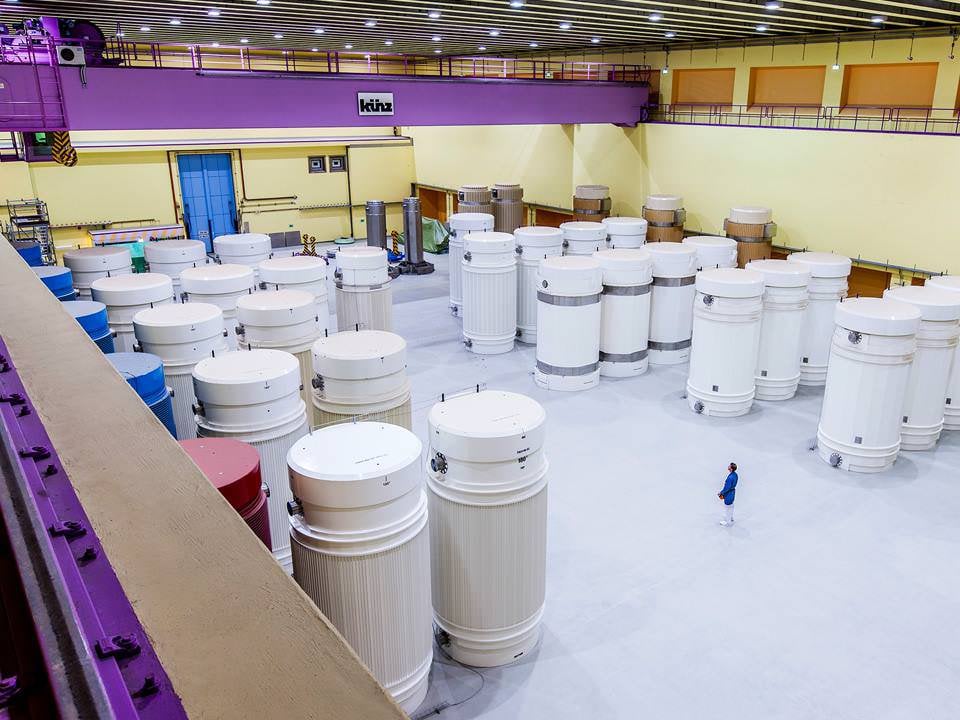 Here’s all of Switzerland’s high level nuclear waste for the last 45 years. It solid pellets. You could fit the entire
 world’sUS’ waste on a football field.It’s not the greatest challenge mankind have faced.
Also want to point out, most of that is container, not spent fuel. The safety standards are so ridiculously high that they basically guarantee zero risk.
More people (per plant) are exposed to elevated levels of radiation due to coal power, and that’s not even including the health risk of all the other shit they release
In Germany, we’ve got a location with 47,000 cubic meters: https://www.bge.de/en/asse/
That requires some pretty tall stacking on that football field. Or I guess, you’re saying if you’d unpack it all and compress it?Also, we really should be getting the nuclear waste out of said location, since there’s a known risk of contamination. But even that challenge is too great for us, apparently.
Mainly, because we don’t have any locations that are considered safe for permanent storage. It’s cool that Switzerland has figured it out. And that some hypothetical football field exists. But it doesn’t exist in Germany, and I’m pretty sure, Switzerland doesn’t want our nuclear waste either.I’m speaking strictly of the mass. Most the volume on those containers are likely structure to make sure there is no accidental leak, similar to Switzerland.
I also misremembered, it was all of US’ waste that could fit on a single football.
Unfortunately, there’s not much structure to these, no. It’s nuclear waste from the 60s and early 70s, when there were practically no safety laws in place yet. They just got dumped down there in steel barrels. In a salt mine, which now has water entering it. I’m hoping, the barrels got at least filled up with concrete, but I have no idea.
we don’t have any locations that are considered safe for permanent storage
I’m gonna hazard a guess that the “consideration” was not from actual scientists but rather activist homeowner groups in every potential site.
NIMBYism and nuclear, name a more iconic duo
I mean, can you blame them? Why would anyone want toxic waste in their backyard? Not to mention that the search is mainly conducted by companies, which have a vested interest in not making all the issues transparent.
Having said that, I am not aware of the ‘scientists’ coming up with good suggestions either. Gorleben got hemmed and hawed around for the longest time, but its selection process was non-scientific from the start.
It’s genuinely not easy to find a location where anyone would be willing to claim that it will remain unaffected by geodynamic processes for millions of years. And we don’t have a big desert or some other unpopulated area where you could chuck it without political opposition, when it’s not 110% safe to do so.
I mean, can you blame them?
Yes. I do it a lot.
Why would anyone want toxic waste in their backyard?
It’s not toxic, nor is it in their backyard.
Not to mention that the search is mainly conducted by companies, which have a vested interest in not making all the issues transparent.
What issues?
It’s genuinely not easy to find a location where anyone would be willing to claim that it will remain unaffected by geodynamic processes for millions of years.
Not Chernobyl?
That too along with 3MI, and decades of negative propaganda from the fossil fuel industry.
I thought that solar panels that old performed much worse or stopped working. Especially considering where the tech was in the 1990s.
I thought that solar panels that old performed much worse or stopped working. Especially considering where the tech was in the 1990s.
“performed much worse” is compared to today’s manufactured panels. As an example, a 100w panel in 1992 was likely around 12% efficient. This means “of all the light energy hitting the full panel under perfect light and temperature conditions”, 12% of that energy is converted to electricity and would produce 100w. Compare this to a middle-of-the-road panel you’d buy for your house today the efficiency is 21%. Both the old and the new panel’s efficiency will go down over the years.
What the article is talking about is how much of the original efficiency is retained over the years in real world tests. Lets say we have a 1992 100w panel from my example above at 12% efficiency. That means under the best possible conditions it would generate 100w. Because of age, the article notes that efficiency has degrade to produce 79.5% of its original rating. Meaning this 1992 100w panel today would generate 79.5w. That’s still pretty darn good and useful!
There is a solar plant in switzerland that still has functioning panels from the early 80s.
E: Oh, the one I thought of was mentioned in the article already.
It’s funny how all the FUD idiots say that solar panels will wind up in the landfill and shit like that
It’s a stupid argument against solar power, but it is a legitimate argument against cheap and poorly-constructed solar panels that do not have the same longevity as the ones built in the 90s.
I still plan on retiring my solar panels once I retire, or later
Just read to the top comment saying it’s profitable to replace them anyway.
And then the top comment to THAT comment wondering where and how to buy the still-effective replaced ones.
Just buy more and put them next to it lmao.
That makes sense, but I guess the problem is that they take up a lot of space.
The weird thing is that in this scenario these panels are still applicable for replacement probably because the the solar panels of today compared to then are about ~40% more efficient. So compared to a new replacement it’s at around 60% efficiency. A major site plans profit off of 30 years and plans to replace glass at that time, so while it may still be somewhat useful long term it’s probably more profitable to replace them.
Oh yeah, how about coal? Does that get any less efficient over time? Exactly. I’ve been burning the same lump of coal for easily the same amount of time and it remains 100% efficient, that’s the beauty of combustible fuel.
/s I’m assuming.
/s or bot or completely degenerate
I’m not familiar with that letter.
Assuming you’re asking in good faith, the “/s” is usually added to denote sarcasm online.
Photo?

That is a very neat bow 😄
I doubt they put out much power at all compared to modern panels. Solar back then was a pipe dream, we didn’t have the battery technology to store the energy and the panels had a lower voltage and could supply less current.
I have a 100w foldable panel for camping that at >= 20% efficiency is probably double what the 90s panels could do.
In the 90s, rooftop solar was around 10-15% efficient. Now rooftop panels are closer to 20%.
A major source of calculator power!
It’s good to know that they have pretty good longevity. One thing complicating this is that panel technology has gotten better and better during that time. There’s a graph on Wikipedia plotting how much better the various types of panel have gotten since the 70s. A lot of them have doubled in output since the early 90s.
So on the one hand, these old panels are outputting 75% of what they started with, which is good. But on then other hand they are only outputting about 37% of what new panels could.
Not that we should throw old panels away. There’s plenty of sun to go around (though I guess the average homeowner only has one roof to use). It’s just interesting how fast the tech has improved and how that might factor in to some longevity calculations.
If that became a problem, every old panel could be changed by newer ones and the old ones could be installed in a desert until their EOL.
Right, they could be installed in the middle of nowhere as free phone chargers and stuff even if there was no other use for them. Just set them up with a used inverter and some used chargers, whatever etc.
Or maybe a whole lot of them could be put together in the middle of nowhere to make an EV charging station
I’m getting some new panels installed this year, and I think they’re suggesting they’ll be at 80% after 25 years.
It looks like there is disagreement between the title and content of the article. Title says 75.9, content says 79.5
Either way, does this suggest that new panels might do better than expected over a 30 year timespan?
deleted by creator