

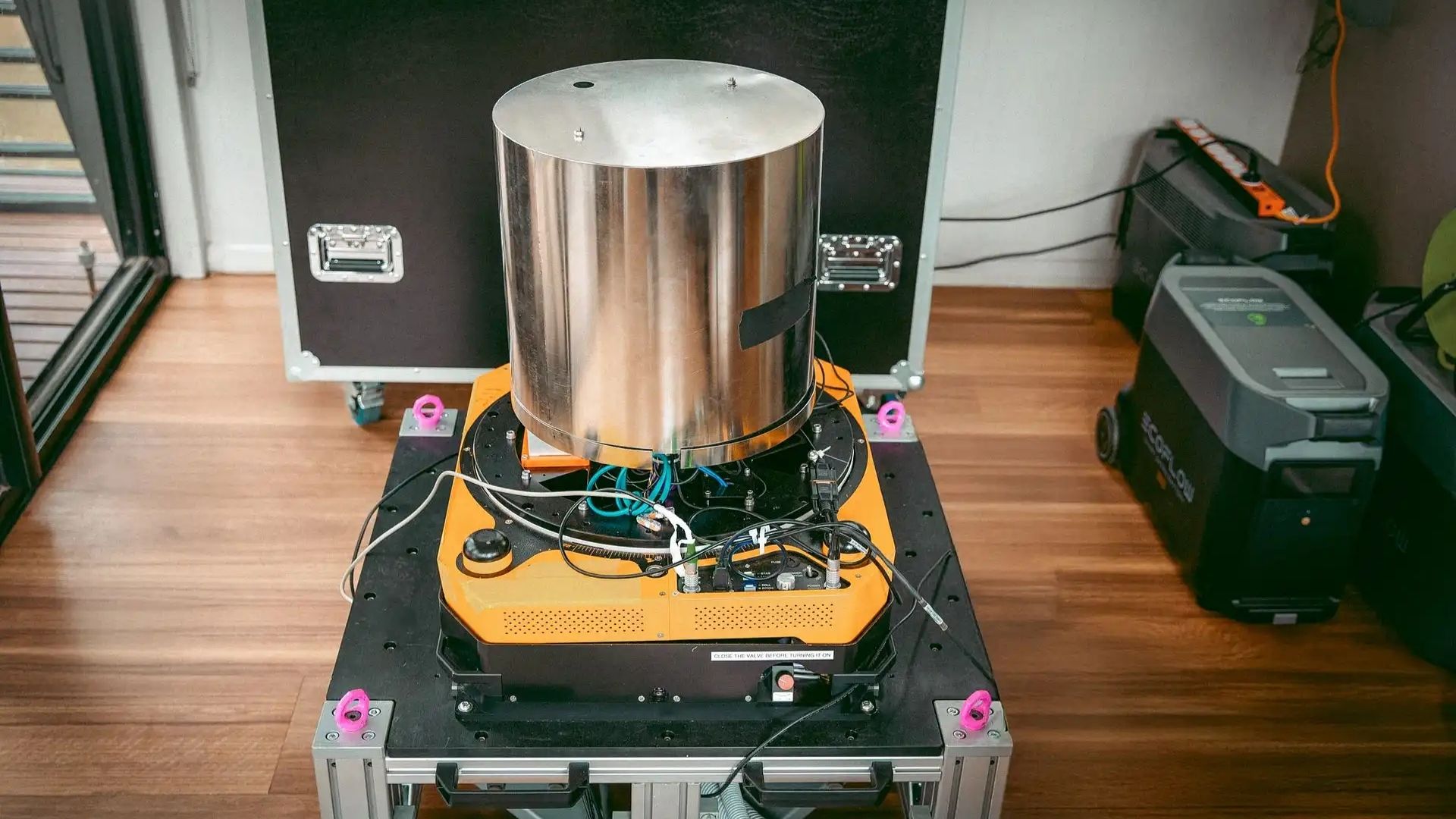
“Quantum sensors can sense the tiniest of changes in the gravity or magnetic field and use a previously prepared map of these properties to determine their location. Since a quantum sensor does not need to receive or send a signal to an external device, it cannot be hacked or be spoofed by a fake incoming signal either. “ Very cool!
*Cant be Non-magnetically hacked
I don’t think it’s realistically possible to do that totally undetected. Since the earth’s magnetic field is so weak and field strength goes down rapidly as distance increases, malicious actors probably couldn’t spoof patterns well enough to make the data look real, at least not without coming very close and staying near their target.
You don’t need to hack the quantum sensor. You’ll hack the regular computer around the sensor.
So, like terrain-matching, but gravity field. Cool!
Two issues I have with the presentation:
A magnetic field is an external signal - the Earth’s magnetic field is actually incredibly weak…
10x better performance than GNSS … positioning accuracy of 1 nautical mile. Cheap old school handheld GPS out in the woods was accurate better than 10 feet most of the time, so what in this performance is 10x better? 10x more resistant to jamming? Seems like it should be completely impervious to jamming. 1 nm accuracy is useful, but hardly better performance.
For those confused:
nm means Nautical mile here, not nano meter
Why do we expect this quantum map of gravity and magnetic fields to be permanent?
It is not permanent, but the changes are slow enough
Navigation with a suitcase sized device that doesn’t rely on hundreds of thousands of satellites? Honestly this sounds great.
Not even thousands
Not even hundreds
Try 31
You’re literally off by a factor of 3225
That’s cool. Seems like an even better reason to use a system that you can carry with you.
This is great because of reason!
Eh, your reasoning is flawed
Even more reason that its great!
… Sure?
Hundred of thousands of satellites? Are you on mushrooms or something?
So, for anyone else who became curious after this exchange:
I tried to look up how many there actually are. It’s hard to give a single number, since there are many different ways to count them, but vaguely speaking it’s in the range of dozens to a few hundred. GPS specifically has had 83 satellites built, of which 31 are currently operational, but most of the others still exist, they’re just parked in a higher orbit for retirement. There’s also GLONASS, BeiDou, Galileo, QZSS, and IRNSS/Navic. QZSS and IRNSS don’t have as many satellites, and the rest are kinda roughly similar in number (e.g. GLONASS has had 146 built and 24 currently operational).
So yeah. Nowhere near hundreds of thousands. Even Starlink, which now comprises more than half of the total satellites of any kind in orbit, has only about 10,000.
Why is hyperbole such a foreign concept on this webzone?
Let me guess you think GPS alone can track someone.
The trouble with Quantum Navigation is you might end up where you were trying to go, but at a random point in the past where you have to change history to put right something that once went wrong.
As long as you keep it below 88 miles per hour you’ll be fine.
Great, now I know my velocity but I don’t know where I am.
You might end up exactly where you want to be, and not want to be at the same time.
And you’ll never be able to return home too.
Perfect for autonomous military robots.
Pretty much, yeah. 💀

I mean GPS was developed for precision munitions. They opened up to the public in 1996ish.
Using quantum sensors, the company achieved ten times the accuracy of conventional satellite-based navigation systems, while maintaining the one nautical mile positioning accuracy.
Don’t we use GPS accurate to within centimeters for construction?
High-end dual-frequency receivers ($$$) can do this, yes. But the earth’s magnetic field is not controlled by any government or military entities. This is pretty big
I see what you mean. Yeah that’s pretty cool then. And I guess it might be impossible to jam quantum GPS.
Username checks out.
Gravitational field. There’s no way you could achieve this with the magnetic field.
Quantum nav… awww man, for a second I thought The Orville was back!
The Quantum Compass! Sick!
The gravitational pull is stronger on the left side so you have to account for that or else you’ll just sail around in circles. /s
Easy to correct - just keep the Skipper in the center of the boat. Gilligan’s pull is negligible.
Most sailors spend their whole lives sailing around in circles
We’re gonna need a bigger drone.
What in the dickins?!
Quantum freaks me out.
How can we possibly make a point we are not in a simulation.No reason to believe we are in a simulation and nothing about quantum suggests we are.
Just what a system administrator would say.

Well, can you make any predictions about the future state of the simulation from present and the rules you think you’ve got right? Just because it is something “computed” from a previous state doesn’t mean that you can compute it yourself…and…if you can’t make predictions…it is just conjecture (limited by our imagination of the state of the art, which now is a simulation, but it used to be god’s creation, then clockwork, then a machine, now a computer/simulation. I can’t imagine what the conjecture will become in the future…hopefully not some shitty spatial diffusion+LLM model where hallucinations are wavefunction collapse to unlikely values, lol.