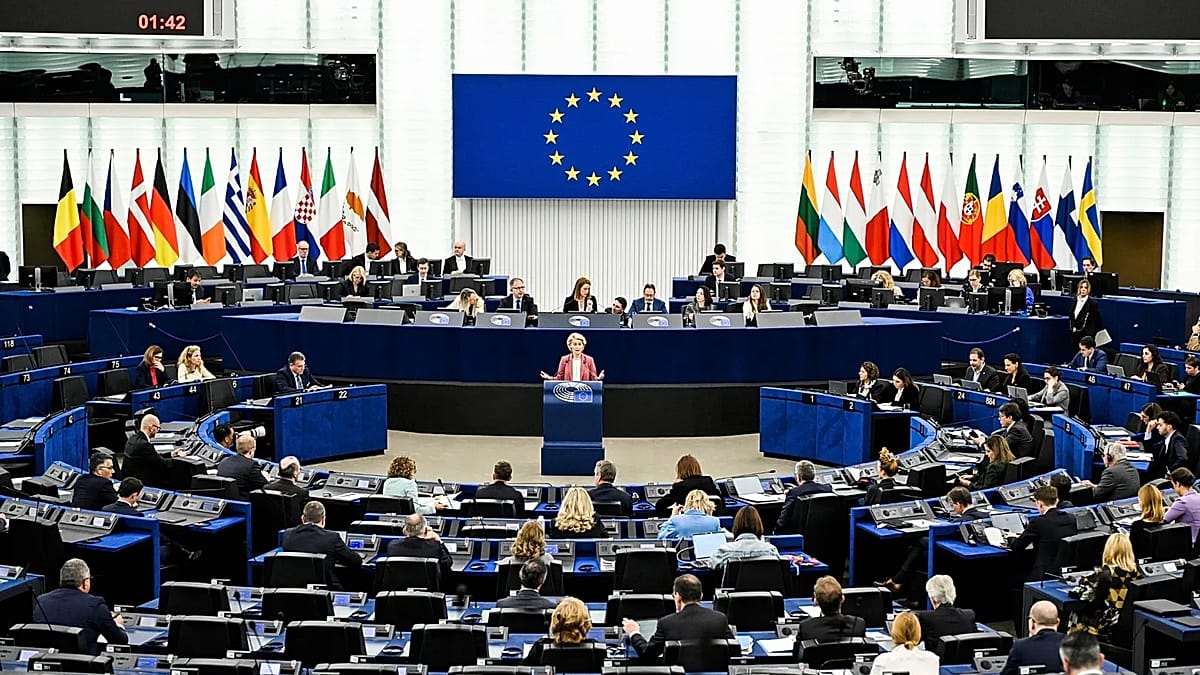
Twelve countries have already backed the initiative, with repeated obstruction by Viktor Orbán's Hungary increasingly fuelling calls for reform. #EuropeNews
The decisions are only important because some want to turn the EU into a country whereas the EU could keep going without the need for further decisions. All other countries could have ignored Hungary and do whatever they wanted since they are souvereign countries. There was no need to act as the EU.
Let’s face it, if you bought 90% of the EU, the last 10% shouldn’t be that big of an issue either
Or they are and that’s why we are going to change the rules.
All other countries could have ignored Hungary and do whatever they wanted since they are souvereign countries. There was no need to act as the EU.
If you completely ignore the fact that Hungary was blocking the release of EU funds, and those don’t just magically reappear in your national budget if the EU doesn’t use them…
They do. If Hungary blocks the EU fund then the money is not spent and the countries can borrow more money because the risk for the lenders doesn’t increase.
The decisions are only important because some want to turn the EU into a country whereas the EU could keep going without the need for further decisions. All other countries could have ignored Hungary and do whatever they wanted since they are souvereign countries.
No, the decisions are important because this way you present EU as an unified block and it has way more bargaining power that every single state. Look at what happened with Brexit
There was no need to act as the EU.
Then there is no need for EU, if every country can go for itself.
The EU started as an American project.
The EU started because after WWII people in Europe decided that maybe, just maybe, to have a war that destroy the continent every 40 years is not a good idea, after all.
What happened that shows that the EU countries outside the EU structure don’t have their united power if they choose to act together?
In the case of Brexit nothing, there were (is) UK on one side that thought they can impose their conditions to EU. We all know how it ended.
BUT if every EU country had dealt with UK as single state, even if working with other countries, the result would have been very different.
Then there is no need for EU, if every country can go for itself.
So the point is ?
I don’t understand what you are thinking, if every country go for itself there is no need for EU but if there is EU is useless because every country can go for itself and just work with the others…
Please read the paragraph of the Wikipedia article around my quote.
The Élysée Treaty was signed after the founding of the first “release” of EU, which was CEE, and was formalized in 1957, 6 years before the Élysée Treaty. And in the Élysée Treaty US or any other country or organization and the US president was not happy about it for example.
BUT if every EU country had dealt with UK as single state, even if working with other countries, the result would have been very different.
Most likely, but they could have created a way to fully copperate.
So the point is ?
The countries don’t need the political structure of the EU. They could cooperate in other ways. Going for itself doesn’t require to act in the most selfish way.
The Élysée Treaty was signed after the founding of the first “release” of EU
That’s a strong argument. There is the desire within Europe to live peacefully together. Unfortunately it doesn’t guarantee that the US haven’t taken over the EU.
BUT if every EU country had dealt with UK as single state, even if working with other countries, the result would have been very different.
Most likely, but they could have created a way to fully copperate.
So they should have something like EU without having something like EU.
So the point is ?
The countries don’t need the political structure of the EU. They could cooperate in other ways. Going for itself doesn’t require to act in the most selfish way.
True, but a political structure like EU solves a lot of problems when you think about cooperating: without EU every cooperation agreement would be a bilateral agreement between two states, and every pair could (and would) be different.
I am old enough to remember how it was to do business before the current EU, not to talk about travelling.
And in the Élysée …
Some words are missing.
You are right, sorry.
I was saying that in the Élysée Treaty, the US, NATO or any other country or organization were never mentioned and the US president at the time (Kennedy) was not happy about it.
Which is why the unanimity rule is obsolete in my opinion. When EU was smaller, it made sense, now not anymore since there is no way that every decision is good for everyone.
Even a single state that had the unanimity rule would be problematic: no decision could be made since nothing will be good for everyone. Same for EU, if we must decide on something and it need to be good for everyone there are 2 cases: 1) your result would be useless since it would be watered down in many ways or 2) you don’t decide.
The countries could just have continued their EU behaviour outside of the EU.
They did, but they did not used the weight of EU, which is bigger than the sum of the single states.
True, but a political structure like EU solves a lot of problems when you think about cooperating
It does. Which makes blocking the EU inconvenient but it doesn’t block the countries.
Again, it is true, you are not blocking the countries. But they have not the same weight of EU.
and the US president at the time (Kennedy) was not happy about it.
The question is why? Did he just want the best for Europe and Nato or was the US losing too much influence?
Obviously because they lost influence.
If you had not noted it, after the Brexit charade (which, btw, demostrate why it is important that EU work as a single entity) EU started to move faster (not always in the correct direction in my opinion) exactly because the United States’ Trojan horse in the EU, the UK, was out of the decision process and cannot block things anymore.
no decision could be made since nothing will be good for everyone.
In a good faith situation, people make compromises. The EU is first of all a trade union. If it is maliciously blocked, just wait it out.
To protect against bad faith actors, only the rule has to be changed that one other complice country can block a voting power reduction. That should be part of the discussion.
but they did not used the weight of EU, which is bigger than the sum of the single states.
If the US does control the EU, and China and Russia know whatever it is, then it is smaller.
EU started to move faster … United States’ Trojan horse in the EU, the UK, was out of the decision process and cannot block things anymore.
Germany is also a Trojan horse, and I have read comments about other countries, too.
I don’t know the inner workings, I can’t even say anything about the speedup, but the UK preferred free markets whereas France prefers state companies. That must have been an endless source for conflicts. I wouldn’t ascribe the entire slowdown to US influence.
I think the Hungary situation was milked to establish the need for a reform. As I wrote at the start, without veto powers, we get closer to the USE. For the USE, that means more power but for the citizens it means less power.


The decisions are only important because some want to turn the EU into a country whereas the EU could keep going without the need for further decisions. All other countries could have ignored Hungary and do whatever they wanted since they are souvereign countries. There was no need to act as the EU.
Or they are and that’s why we are going to change the rules.
The EU started as an American project.
Did the EU become independent or was de Gaulle wrong?
If you completely ignore the fact that Hungary was blocking the release of EU funds, and those don’t just magically reappear in your national budget if the EU doesn’t use them…
They do. If Hungary blocks the EU fund then the money is not spent and the countries can borrow more money because the risk for the lenders doesn’t increase.
No, the decisions are important because this way you present EU as an unified block and it has way more bargaining power that every single state. Look at what happened with Brexit
Then there is no need for EU, if every country can go for itself.
The EU started because after WWII people in Europe decided that maybe, just maybe, to have a war that destroy the continent every 40 years is not a good idea, after all.
What happened that shows that the EU countries outside the EU structure don’t have their united power if they choose to act together?
The opposite. There is no need for the EU if all countries just work together.
Please read the paragraph of the Wikipedia article around my quote.
In the case of Brexit nothing, there were (is) UK on one side that thought they can impose their conditions to EU. We all know how it ended.
BUT if every EU country had dealt with UK as single state, even if working with other countries, the result would have been very different.
So the point is ?
I don’t understand what you are thinking, if every country go for itself there is no need for EU but if there is EU is useless because every country can go for itself and just work with the others…
The Élysée Treaty was signed after the founding of the first “release” of EU, which was CEE, and was formalized in 1957, 6 years before the Élysée Treaty. And in the Élysée Treaty US or any other country or organization and the US president was not happy about it for example.
Most likely, but they could have created a way to fully copperate.
The countries don’t need the political structure of the EU. They could cooperate in other ways. Going for itself doesn’t require to act in the most selfish way.
That’s a strong argument. There is the desire within Europe to live peacefully together. Unfortunately it doesn’t guarantee that the US haven’t taken over the EU.
Some words are missing.
So they should have something like EU without having something like EU.
True, but a political structure like EU solves a lot of problems when you think about cooperating: without EU every cooperation agreement would be a bilateral agreement between two states, and every pair could (and would) be different.
I am old enough to remember how it was to do business before the current EU, not to talk about travelling.
You are right, sorry.
I was saying that in the Élysée Treaty, the US, NATO or any other country or organization were never mentioned and the US president at the time (Kennedy) was not happy about it.
Yes. We started with Hungary blocking the EU. The countries could just have continued their EU behaviour outside of the EU.
It does. Which makes blocking the EU inconvenient but it doesn’t block the countries.
The question is why? Did he just want the best for Europe and Nato or was the US losing too much influence?
Which is why the unanimity rule is obsolete in my opinion. When EU was smaller, it made sense, now not anymore since there is no way that every decision is good for everyone.
Even a single state that had the unanimity rule would be problematic: no decision could be made since nothing will be good for everyone. Same for EU, if we must decide on something and it need to be good for everyone there are 2 cases: 1) your result would be useless since it would be watered down in many ways or 2) you don’t decide.
They did, but they did not used the weight of EU, which is bigger than the sum of the single states.
Again, it is true, you are not blocking the countries. But they have not the same weight of EU.
Obviously because they lost influence.
If you had not noted it, after the Brexit charade (which, btw, demostrate why it is important that EU work as a single entity) EU started to move faster (not always in the correct direction in my opinion) exactly because the United States’ Trojan horse in the EU, the UK, was out of the decision process and cannot block things anymore.
In a good faith situation, people make compromises. The EU is first of all a trade union. If it is maliciously blocked, just wait it out.
To protect against bad faith actors, only the rule has to be changed that one other complice country can block a voting power reduction. That should be part of the discussion.
If the US does control the EU, and China and Russia know whatever it is, then it is smaller.
Germany is also a Trojan horse, and I have read comments about other countries, too.
I don’t know the inner workings, I can’t even say anything about the speedup, but the UK preferred free markets whereas France prefers state companies. That must have been an endless source for conflicts. I wouldn’t ascribe the entire slowdown to US influence.
I think the Hungary situation was milked to establish the need for a reform. As I wrote at the start, without veto powers, we get closer to the USE. For the USE, that means more power but for the citizens it means less power.