
The first intentional radio broadcast is credited to Reginald Aubrey Fessenden on December 24, 1906. Fessenden transmitted voice and music (a short speech, a violin performance of O Holy Night, and a Bible reading). Prior to this, radio signals were mostly Morse code. This was the first known broadcast meant to be heard by a general audience as sound. And it’s said that ship radio operators in the Atlantic, who heard it, were astonished to hear music and speech over their receivers!
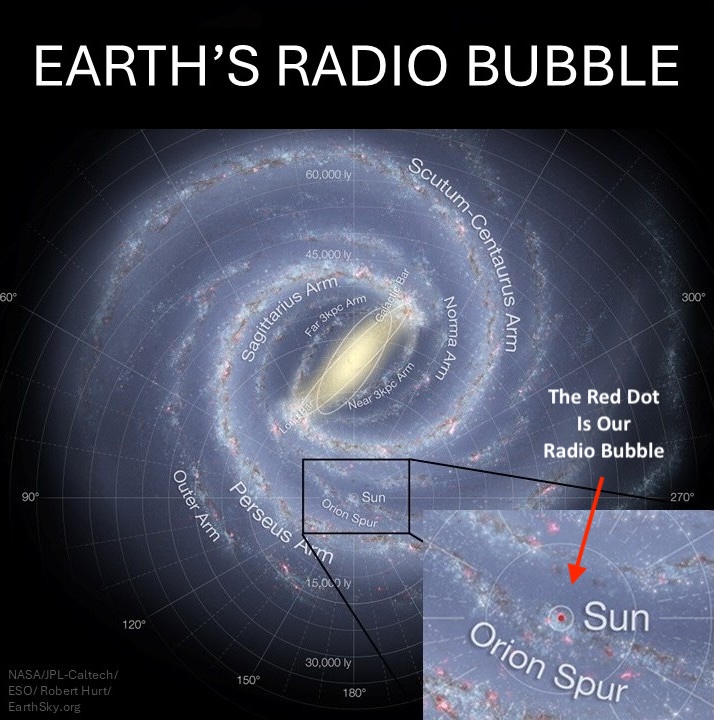
And now, more than a century later, the radio waves that transmitted Fessenden’s broadcast – and many more radio waves since then – are still traveling outward into our Milky Way galaxy. But just how far have our radio waves reached? Radio waves are part of the electromagnetic spectrum, so they travel at the speed of light. And it’s been 119 years since that first radio broadcast.
So the radius of Earth’s radio bubble is 119 light-years, or a sphere with a diameter of 238 light-years across.
Please note that the inverse square law applies here, so with distance it becomes much harder to detect those signals over other noise. Not impossible exactly, but exceedingly hard the further you go. There is some practical limit to where the signal to noise ratio becomes such that it’s impossible to extract any meaningful information.