

Title text:
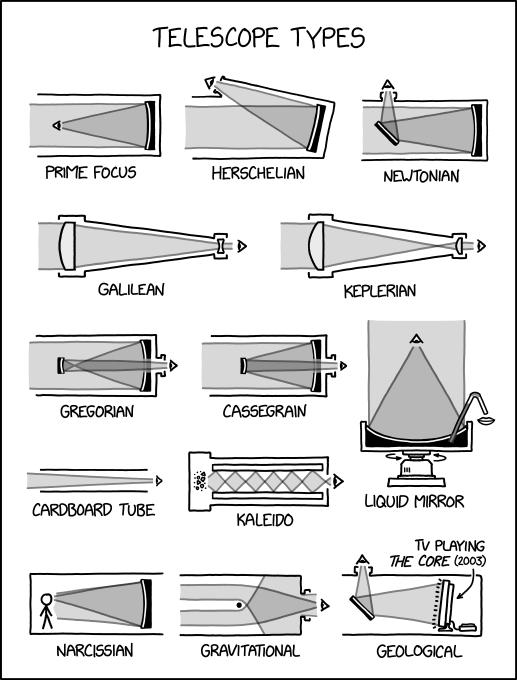
I’m trying to buy a gravitational lens for my camera, but I can’t tell if the manufacturers are listing comoving focal length or proper focal length.
Transcript:
Transcript will show once it’s been added to explainxkcd.com
Source: https://xkcd.com/3182/
Anyone want to tell me how the telescopes where the mirror is in the middle of the aperture sometimes still show the image without a big dot/wires holding the mirror in what you see? It’s smack in the middle you’d think it would block the view.
Like others have mentioned, the spider (the wires) and the secondary do shadow some light that would otherwise reach the primary. It also results in some artifacts due to diffraction; the view ends up convolved with the Fourier transform of the aperture. This is why on Hubble images, you see cross shaped stars, as that’s the shape of the Fourier transform of its 4-strut spider.
Not an expert, but as far as I know, you nearly never see a true single picture, but always a combined one. So they take multiple slightly overlapping pictures who are seeing the hidden middle spot of other pictures.
This also helps by making sure what you see on one picture is also there on other pictures and not just a random dust particle in the air or some other thing on earth/in its atmosphere rather than an object in outer space.