
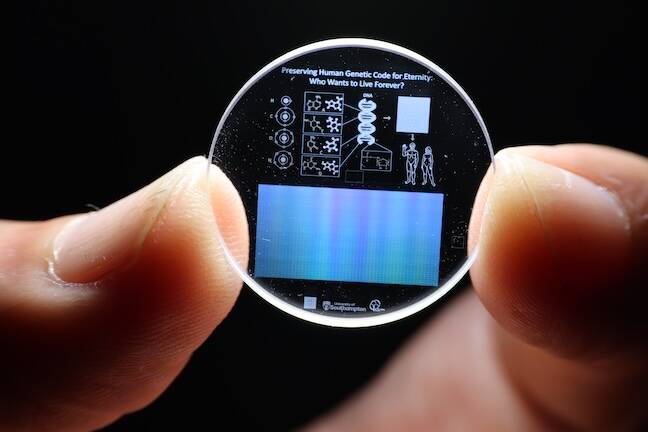
“the medium is silica crystal, similar to optical cable, it’s highly durable. It’s also capacious: The technology can store up to 360 TB of data on a 5-inch glass platter.”
@remindme@mstdn.social 14,000,000,000 years
Removed by mod
I wonder what the read write speed is. Imagine storing your entire movie collection in a crystal the size of a coaster.
Might not be for home consumers anytime soon, article says: “In the next 18 months, the company hopes to have a field-deployable read device that customers can use to read archived data. But SPhotonix isn’t presently targeting the consumer market. Kazansky estimates that the initial cost of the read device will be about $6,000 and the initial cost of the write device will be about $30,000.”
Then goes on to mention they need about 3-4 years of R&D so they can be ready to license the tech
In case you missed it in the article, the transfer speeds are mentioned just two paragraphs prior to the one you cited:
Over the next three to four years, Kazansky said, SPhotonix aims to improve the data transfer speed of its technology from a write time of 4 megabytes per second (MBps) and read time of 30 MBps to a read/write speed of 500 MBps, which would be competitive with archival tape backup systems.
Writing 360 TB at 4 MB/s will take over 1000 days, almost 3 years. Retrieving 360 TB at a rate of 30 MB/s is about 138 days. That capacity to bitrate ratio that is going to be really hard to use in a practical way, and it’ll be critical to get that speed up. Their target of 500 MB/s is still more than 8 days to read or write the data from one storage platter.
I was so blind sided by the fact that the tech isn’t for consumers that I forgot to mention the r/w speeds
That’s the joke. The speed of a lot of these tech would require twice the time the data retention to write it.
We can place atoms in order on the head of this pin and store 30 Pb. Write speed? 1KB/min
Did you read the article? 30mbps is faster than a lot of people’s internets. It’s not fast, but for a prototype, it’s not bad.
You need to put the capacity into perspective with the storage speed. The comment I made simply highlighted the issue with an extreme example… For the reasoning provided. And as someone who’s worked with emerging tech before… 30 Mbps is their ideal lap time in a lab environment. Do remember that 100 Mbps is considered absurdly slow for networking. 1Gbps sounds fast but even those transfer rates move into hours and days for larger file transfers.
This is explicitly stated to be for cold storage though. It doesn’t have to be fast at all. And they’re supposedly aiming for 500mbps soon.
They are at 30 presently. The “standard” is somewhere around 300-500 which, again, is acceptable for cold storage at the current tape drive size of 10-30tb.
There are minimums expected as density increases. Cold storage / backup still needs this to be viable.
I suppose it could be considered a trade-off? There’s the obvious advantages of longevity and possible size(?), it van still be viable in some niche uses where that matters. Github’s code vault from a while back could have benefited from that.
We are talking theoretical here, of course. For enterprise to even give it a realistic look it needs to outperform very time tested equipment so… Were probably looking at needing to beat on cost, capacity, speed… Or to put it simply its actual value / cost for implementation. Currently there are a few different research grade projects at various stages of lab testing… And this, like those, needs to fundamentally provide (noteworthy) gains over the existing and also be able to be consistent outside of the lab. Were a fair bit away from that yet.
I mentioned earlier that we are in dire need of meaningful, long term, non-magnetic storage… And I genuinely believe that. But while I can be interested in the tech - it still needs to be viewed with a critical eye until it can produce results.
That’s cheap enough a small business could do long term backups for individuals and other small businesses.
Manipulating the atoms in a crystal to store info is extremely high-precision, as is verifying the accuracy of the write). So is reading positions down to a few nanometers, But consumers wouldn’t need a $6000 reader to get, say, 10GB dumped to a hard drive … you’d carry your crystal and 16GB drive down to the corner store and user their reader to dump sector 37BJ to the drive. No need to trust them with your platter … but are you exposing all 360TB to potential damage from the machine?
This grinds my gears any time that a product is touted as lasting X time. Did you put it through a typical use case or scenario for that X time? No? Then you cannot definitively say that it will last that long.
Based on their bullshit statement, I can last 7 years pounding someone’s ass relentlessly without pause for any reason. Trust me bro.
You can stimulate wear on different types of materials and get a general idea of how long it would last. This isn’t plastic in a dvd.
I mean, people do predict things based on evidence. Galileo didn’t actually go to outer space and verify that the earth was going around the sun.
Beyond that, the sun has about 5 billion years before we might not be able to starlift it back to a “younger” state, so The Earth and Venus may not exist at all if we don’t get our asses in gear for sustainable intragalactic life in the next century or so.
I am failing to connect the two time scales you mention.
The storage device can’t outlast the Sun.
and just like every other storage medium, it will last for eons…and die about .5 femtoseconds before you have a critical need to pull data off.
Best prank idea: Put someone’s browsing history on one of those.
Pondering my backup orb
What if some civilization in the past already had something like this, and there are ‘plates’ or pieces of rock out there (under sand dunes? written in the sides of those vases from ancient Egypt?)
Could they make portable readers that can at least spot old pottery chunks that are probably FULL of videos?
It will not.
For real, what am I going to do when the sun swallows the earth in 4 billion years?
You may be entitled to compensation
Any number I could call?
Open AI just bought out all the glass platter production. Not only will consumers not be able to store their data for 14gy, they won’t have anywhere to set down their drinks either
Sauce? Or sarcasm?
Really?
I been wooshed, sorry v.v
It’s like that these days. It’s hard to tell.
Oh good it can fit the next Call of Duty game.
Waiting for the consumer reader and writer of those things, call me then
Not the business plan. This will be used as an archiving service for $$$.
“We are a technology licensing company”
This is good news from the point of view of being able to create devices that can read these crystals; as a comment on the linked site says:
The realistic lifetime of storage is the life of the last manufactured or surviving retrieval device.
Denis Villeneuve nailed it years ago.

Similar concepts have been developed before, Microsoft and Southampton University were working on glass cubes with 3D laser etchings in the centre around 2015-16

(now divorced)
I’ve seen this particular revolutionary technology come by about once a year for the past two decades or so, so let’s say I’m not holding my breath and I will toss this one on the large pile of “bullshit tech articles”
If it is so easy to write to, seems it would be equally easy to erase
Bro has never used a permanent marker
A little bit of rubbing alcohol and it comes right off
Depends on the surface the marker was used on.
Good point. In my lab I’ve used ethanol and acetone as well.
Meh…. Japan’s been pitching holographic data storage since the early 2Ks — at least —LMK when I can buy a magic holographic zip drive and I’ll be back.