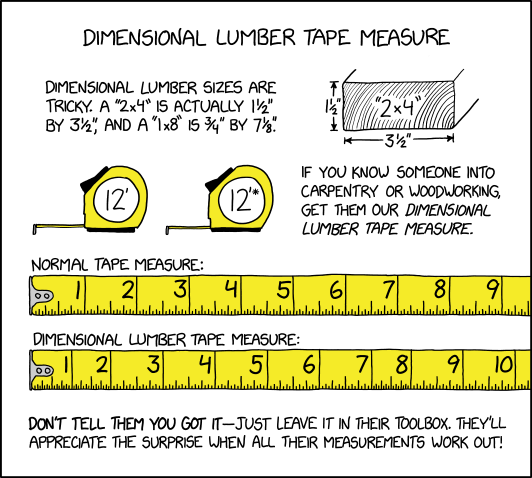
xkcd #3138: Dimensional Lumber Tape Measure
Title text:
A person with two watches is never sure what time it is, especially if I got them one of the watches.
Transcript:
Transcript will show once it’s been added to explainxkcd.com
Source: https://xkcd.com/3138/
You must log in or # to comment.
Interestingly enough, this concept was used in pattern making for casting machine parts back before modern machining and parts manufacturing.
They were colloquially called shrink rulers, and looked like a standard ruler, but were actually longer to account for the shrinkage of the material being cast.
For example, say you’re casting a part from iron, which shrinks 1% as it cools, which amounts to 1/8 inch per foot.
An iron shrink rule would look standard, but actually measure a foot as 1 foot 1/8 inches to account for the shrinkage (this is an example and not meant to be actually accurate).
Source: am historian that interviewed pattern makers that used shrink rulers in their work.
Edit: spelling
It shrinks? Like a frightened turtle!
That’s what happens when things cool down… It is the cold, that why it looks small 😳
Neat!
I need to get a shrink tape ruler like this. I own a skoolie (used school bus converted to a motorhome) which is 35’ 4" long from bumper-to-bumper. A lot of campsites have rules where RVs can’t be longer than 35’. My thought was to get a tape measure with feet just slightly longer than normal and use it to make my bus appear to be shorter than 35’.
At one time a 2 x 4 really was 2" x 4". Very old houses will have these in the walls, not planed and quite rough and splintery. I think I still have splinters from the 1913 bungalow I renovated more than 30 years ago.
I’ve worked on a lot of pre-1900 houses (I even grew up in one) and the 2x4s from back then really were 2" x 4" instead of the modern 1.5" x 3.5". Two years ago I bought a house built in 1942 and I demolished one interior wall and re-used the studs from it to build some new walls. I kept building these walls 1/2" too tall even though I measured and re-measured the spaces I was putting them into very carefully. I eventually realized that these 1942 studs were not in fact 1.5" x 3.5" like I had been assuming, but were actually 1.75" x 3.75" (the extra 1/4" in width of the top and bottom plates of my walls is where the phantom extra 1/2" was coming from). So apparently there was a transitional period between the real 2" x 4" 2x4s and the 1.5" x 3.5" ones.
I discovered another weird transitional thing in this house. The old houses I worked on all had lath-and-plaster walls, with strips of rough wood lath covered with a thick rough plaster layer which was in turn covered with a thin smooth plaster layer. Modern houses of course use sheetrock, but my 1942 house covered the bare studs with 16" x 16" pre-formed interlocking blocks of 1" thick rough plaster, and then smooth plaster was laid over these blocks. I first encountered these when tearing down the ceiling in my kitchen, and these things were unbelievably fucking heavy. They basically weighed as much as solid stone of these dimensions, and I can’t imagine what it must have been like to install them initially. It surely must have been a two-man job.
Edit: another fun experience I had was renovating an Atlanta house that had been built in 1843. When we tore down the original lath-and-plaster walls, we found embedded in every single wall and ceiling a single dead, flattened rat. That house must have stunk to high fucking hell when they first moved into it. I like to imagine that it had been built with slave labor and this was some well-deserved payback.
Interesting. We found some 3/8" drywall in the 1913 house, dating from some renovations that appeared to have been done in the 1950s or 60s. We also found a mummified sandwich.
Huh, the explain link says the dimensional sizes originated from the wood being cut at the listed size while green, then shrinking as it dried. I was told that it was done for construction purposes, where the wood would likely be covered by plywood or drywall that would bring the dimension up to size. I never questioned it before; that always seemed plausible enough.
None of the above is true, or at least isn’t the full answer for why today a “2x4” is missing an entire half an inch all the way around. The shrinkage due to drying is around 5% (and the real math there is more complicated, as wood shrinks different amounts in different directions relative to the grain), which would only account for 1/10" of difference in the thickness of a 2x4. With some species of pine it’s as low as 2%.
No, the lumber industry has consistently shaved boards in order to fit more into rail cars for transport and make more money and spend less per plank on transportation costs. Various lumber consortiums determined via internal testing that the smaller board sizes are still “sufficient” for their intended purpose vis-a-vis structural integrity of stick framed residential buildings.
that’s one of the common excuses that the mills quote. It’s bullshit of course, but it sounds plausible so they continue to get away with it.
Another bullshit excuse is that they’re providing an additional service by milling and planing the lumber for you, and that the nominal measurement is before that process.
It’s all just greed. If they could get away with selling a 2x4 that was half an inch thick, they would. At least it’s all standardized now.
I don’t think this is true. There was a transitional period around the 1940s where 2x4s were 1.75" x 3.75", and that wasn’t because wood shrunk half as much as it does today.
Modern lumber is planed, so some of that difference is because of losses from that. If you open up the walls of a house built 100+ years ago, you see these thick rough wall studs that never went through a planer. Even with shrinking, it’s close to being actual 2" x 4".
This is how you become a character in House of Leaves.
Its 2x4 before drying and planing.
Maybe I’m being daft (I probably am).
After wood is planed and dried, I thought it would have gotten smaller.
In the image, 9CM lumber measurement is smaller than 9CM metric. Meaning when 9CM lumber shrinks it’ll be even smaller than the 9CM metric.
Have I got this backwards?
The joke is when you purchase a 2x4, it measures 1.5x3.5 and not the advertised 2x4.
lol, learn something new every day!
The tree was 2x4, I’ve no idea what they’ve done with it.
As if they did not have enough issues with their backwater imperial units…
pretty sure its been modified for one as an excuse to cut costs but the excuse is that it allows clearance for remodeling since in the 1900s a 2x4 WAS a 2x4 but with wear and tear smaller size 2x4s were easier for renovations.
I thought it was rough-cut dimensions.
I’ve always chalked it up to shrinkage of the product during storage and shipping
Can still work as long as you use the same ruler and just use referenced measurements.
There really is an xkcd for everything.