Title text:
I’m excited for Dragonfly, because on the list of places in the solar system that I desperately want more pictures from, ‘Titan’s surface’ is right up there at the top with ‘Jupiter’s atmosphere.’
Transcript:
Transcript will show once it’s been added to explainxkcd.com
Source: https://xkcd.com/3322/
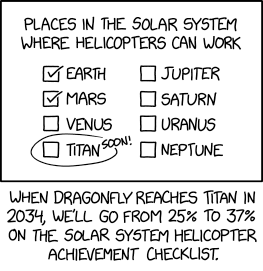
Sure. 25% --> 37% … as long as you (for some arbitrary reason) only consider 8 “places” in the solar system.
7 of those are planets, but Titan is a moon. If we’re going to include moons, then there’s going to be a whole lot more than 8 “places” in the solar system, so the percentage of places where helicopters can work is going to be greatly reduced. If we get really pedantic and consider any orbiting body in the solar system to be a “place”, then there will be hundreds, thousands of them where helicopters can’t possibly work, once you start tallying up asteroids and comets.
Also, why does the list include 7 planets, not 8? What? Are you not interested in trying to make a helicopter work on Mercury? That’s quitter talk!
Places where helicopters can work is places with sufficient atmosphere, which is why the list is what it is
Ah, but what if you brought a large balloon, inflated it, and flew a helicopter inside the balloon?
Jupiter is already on the list…
Blowing my mind that Gas Giants are just big ole balloons
It’s an inside out balloon! Gravity holds the atmosphere in, not a cloth sheet
And I have a hard time believing that there isn’t some solid or liquid (or maybe some other exotic state of matter, due to the heat and pressure) inner core way down in there, even if it’s relatively tiny compared to the size of the planet.
Even if it was entirely made of gas when it formed, surely some materials would have fallen in over the eons that could stay solid/liquid at the pressure/temperature of a gas giant’s core?
There is a core, it’s just comparatively tiny and does not have a clear boundary
Yes, other elements/compounds have fallen into Jupiter over the aeons but even if it was just hydrogen, it is big enough that the pressure alone causes a transition between gas and liquid and farther down solid. There just isn’t a set border where you can say that it is one phase on the one side and a different phase on the other. It does more of a slow transition where the gas gets thicker and thicker until at some point you can say it’s definitely a liquid instead of a gas, which then gets thicker and thicker until it’s not moving anymore.
Similar for Saturn.
i see, gravity is made out of cotton
I think it’s saying those are the eight places a helicopter could work, and we are checking them off as we accomplish them.
Helicopters require atmosphere (obviously), so this is a list of the eight bodies in the solar system with atmosphere sufficient for heavier-than-air flight.
Mercury basically doesn’t have an atmosphere for instance, which is probably why it’s not on the list.
A Jupiter chopper would be insane.
That’s 50% of those places that we also know how to land on, soon to be 75%.
Maybe some design could also work on Neptune’s moon, Triton?
I’m not smart enough to do the numbers, but looking at how thin Triton’s atmosphere is you would need a ridiculously large rotor to move enough air and being able to power that in the cold air with limited sunlight would make it pretty impractical. The need for a helicopter would be less useful here too, given you can take satellite imagery with high clarity thanks to that thin atmosphere.