

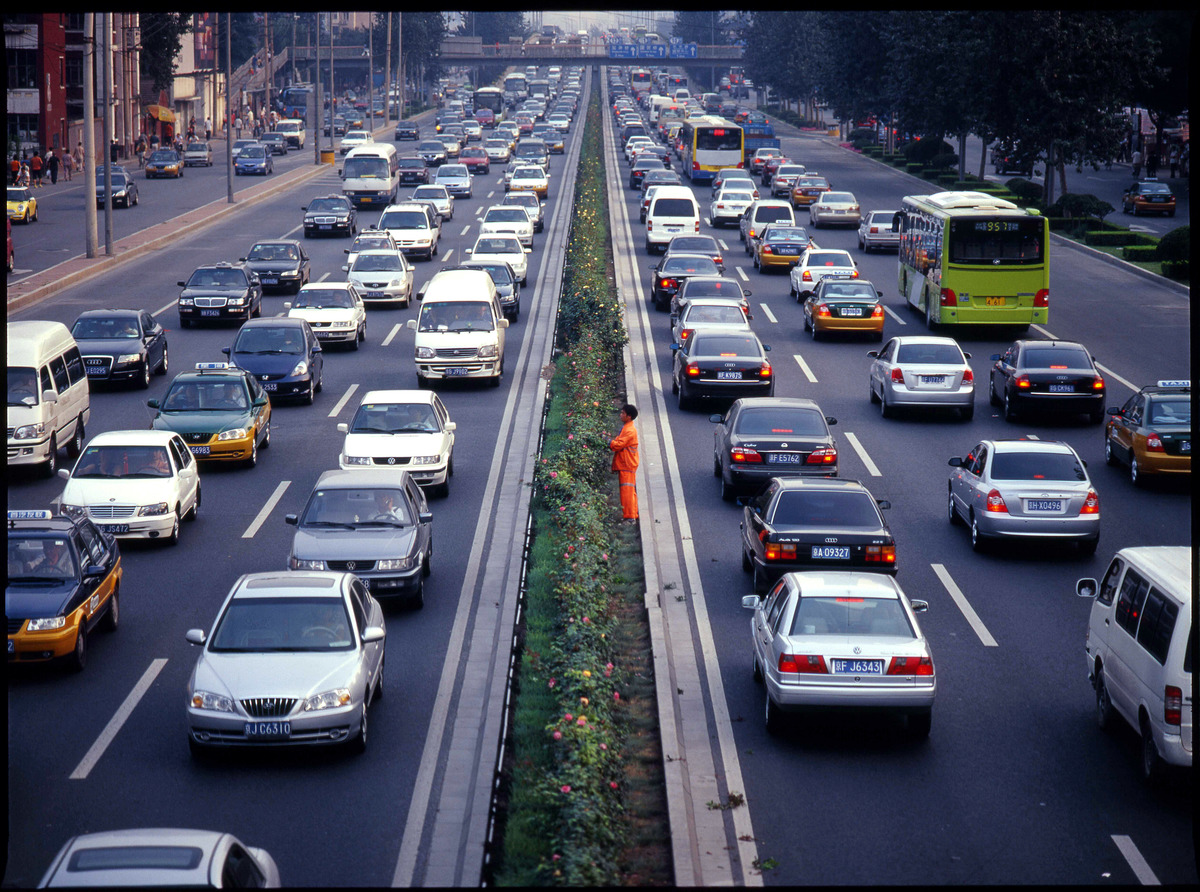
Though progress is often slow, city planners and politicians are gradually waking up to the fact that when cities offer safe and affordable alternatives to cars, we start to travel differently.
More and more young people are choosing bicycles, buses and trains over owning a car out of the sheer cost. In Berlin, it’s public transport, not cars, which is the coolest way of getting around.
In Copenhagen, a city that has a long held reputation for being bike-friendly, a whopping 62% of people choose to cycle their commute.
In the French city of Lyon, the number of cars entering the city has fallen by 20% compared to just a decade ago. As the city’s network of bike hire stations continues to grow, town planners are hoping for a further 20% decline.
In London, where cycle super-highways are becoming popular, the share of journeys made by car has fallen by a quarter since 1990.
Car free days are rising in popularity in many of the world’s largest cities, giving people a taste of what it’s like to live with less noise, traffic and pollution. Bogota was one of the first cities to introduce a car free day, and it’s now become so popular that it’s been extended to a full week.
Bogotá’s Ciclovía is fantastic! I was there in the mid-nineties and they closed a major artery, the Carretera Séptima, on Sundays. Here some pictures.
In Copenhagen, a city that has a long held reputation for being bike-friendly, a whopping 62% of people choose to cycle their commute.
I did that too when I lived in Copenhagen. And it’s also the fastest way to get around.
But now I live in the countryside, and here we absolutely need cars, but everyone on my road drive electric, and half of us have solar panels. So in that way I don’t think our environmental footprint is worse than living in an apartment in the city. Because we to a large degree are energy self sustained.The problems of car dependency go beyond carbon, though - it’s also about road danger, space demand, micro plastics, the exclusion from society of people who can’t afford cars, the exclusion of disabled people, etc etc. Changing the engine doesn’t address these and we need to work towards reducing reliance on this form of transport
IMO the best way to get rid of cars (in your own life) is to not live on the countryside.
Not to disagree, but better only have those problems and not have those problems and fossil fuel emissions. Working towards that goal is much more sensible in the places with high density populations.
That too DEI! But seriously, that Ciclovia looks really nice.
deleted by creator
(The, now deleted, argument was that Greenpeace is supposedly not credible becaused they supported the anti-nuclear movement. Which, according to them, hampered climate protection)
It is right that nuclear plants emit less CO2 per unit of energy than coal plants. That does not mean that it is right to put any money in that, because for the money which would be needed to produce 1 GWh of nuclear power, many times of that amount could be produced by much cheaper renewable power - and in far less construction time.
Ultimately, it is not relevant if for a first, 1% or 3% of backup energy is generated by gas plants, and 97% to 99% by cheap renewables. Again, reducing CO2 emissions at the scale we need is a quantitative-economical problem, and if for the money that would be needed to get electricity production 100% clean right now, we could, say, improve insulation of 30% of our countries houses, and install heat pumps there, more would be achieved in shorter time.
And a third thing - it is often represented as if the goal of nuclear power was to replace coal and gas plants. That was never the case. Suggesting this is misinformation. The idea was always to have a cheap baseline source from the nuke plants which would cover the minimum of each day - perhaps 10% of the daily maximum - and cover the rest mostly by also cheap coal and gas power plants. That was the goal of the electricity companies which operated both coal and nuclear plants. Producing peak load from nuke plants would not have been economical, and was never the goal. (And the only exceptions are countries like France, which build their nuclear fleet for the sake of producing own nuclear arms - at whatever price.)
The whole discussion about nuclear power by the ecological movement since the 1970ies was to provide a clean and safe alternative to nuclear plants.
Do you see what this logo shows in its center? It was designed in 1975:

That was the goal of the environmental and the anti-nuclear movement and the greens. I am honoured to have been able to work and contribute a tiny little bit to that goal - together with many, many brilliant scientists, engineers, inventors, enrepreneurs, and crazy people. We did succeed to made it possible.
By about 2000, we had Megawatt wind power plants and the technical base for that was ready.
Mankind is holding the keys to our future in their hands. Don’t throw them away, the alternative is planetary hell.
Everything in the 25 years since was foot-dragging by conservative politicians, fossil lobbism, and often fossil corruption.
P.S. I see that often that somebody posts some at least misinformed, perhaps misleading argument - and when a good counter-argument is posted, the first argument is deleted. This lets me think in astroturfing.
Another pattern that I am seeing now that when I post something around the topic of sustaiability / fossil fuels etc., I get plenty of highly critical comments around posts that I make around other, completely different topics (say, Linux window managers). Most of these critical comments have no logical substance - what they aim at is to discredit and leave a bad atmosphere and mood.
“Though progress is often slow, city planners and politicians are gradually waking up to the fact that when cities offer safe and affordable alternatives to cars, we start to travel differently.”
How do I even take this sentence seriously. Like what the fuck did they think we were supposed to do? Band together as citizens and build bike paths or metro infrastructure? You gave us limited options for transport and then was surprised it was your job to provide the alternatives?? Either that sentence is a complete lie or they are truly walking around with a completely empty head.
If you live in a democracy, you were supposed to support candidates that make better choices. If no such candidate exists, you’re supposed to make them. Instead you assumed that something supposed to happen to you without your input. Well, something did, why are you surprised it’s not catered to your interests
Everything starts somewhere. The Netherlands were a car country through and through. That was until more and more people rejected it and they slowly built the infrastructure for bicycles, trains and walkable city centers over several decades they are famous for today.
Our biggest problem in the fight for cleaner, safer and overall better infrastructure are the car and oil lobbies for sure. They learned their lessons from the Netherlands too and fight every cycling lane with tooth and nail. But they can‘t fight progress when the cost of everything is becoming too high. People demand more efficiency than cars, be they electric or not, can offer.
My problem with this at the core is that they are blatantly lying to everyone. There is no way none of them realized the solution to less cars was to provide people with alternative transport. There is a zero percent chance of that. And the fact that they would lie and say they are just realizing it is what pisses me off. Everyone knows oil lords control the world, everyone knows renewable energy, electric vehicles, public infrastructure etc. has been hindered because of them. They are treating the public like toddlers who can’t differentiate between truth and absolute bollocks.
renewable energy took a long time to take off because the cost of it had to fall low enough first, which can only happen through substantial subsidies, which only germany and china were willing to do. germany cancelled the project sometime around 2012 while china pulled all the way through.
You should look into how oil industry lobbying has affected green energy since the 60s
I’m sure some people would be surprised that people would choose not to use a car assuming rather that the perceived convenience of it would trump everything else
You just reminded me I need to work on my tricycle’s a/c (a big ice block bungeed to my cargo basket)

