


great scott
Goddammit, they are 0.01 Gigawatt short of time travel. 😋
1.21 Jiggowatts?! Is there a GIF?
No, only a GIF.
Great Scott!
You pronounce the G the same way as in gigawatt.
But what about the F? Is it pronounced like phhhh, or like ffffff?
ffffff which can be written fff and is pronounced white
What the hell is a jiggawatt?!
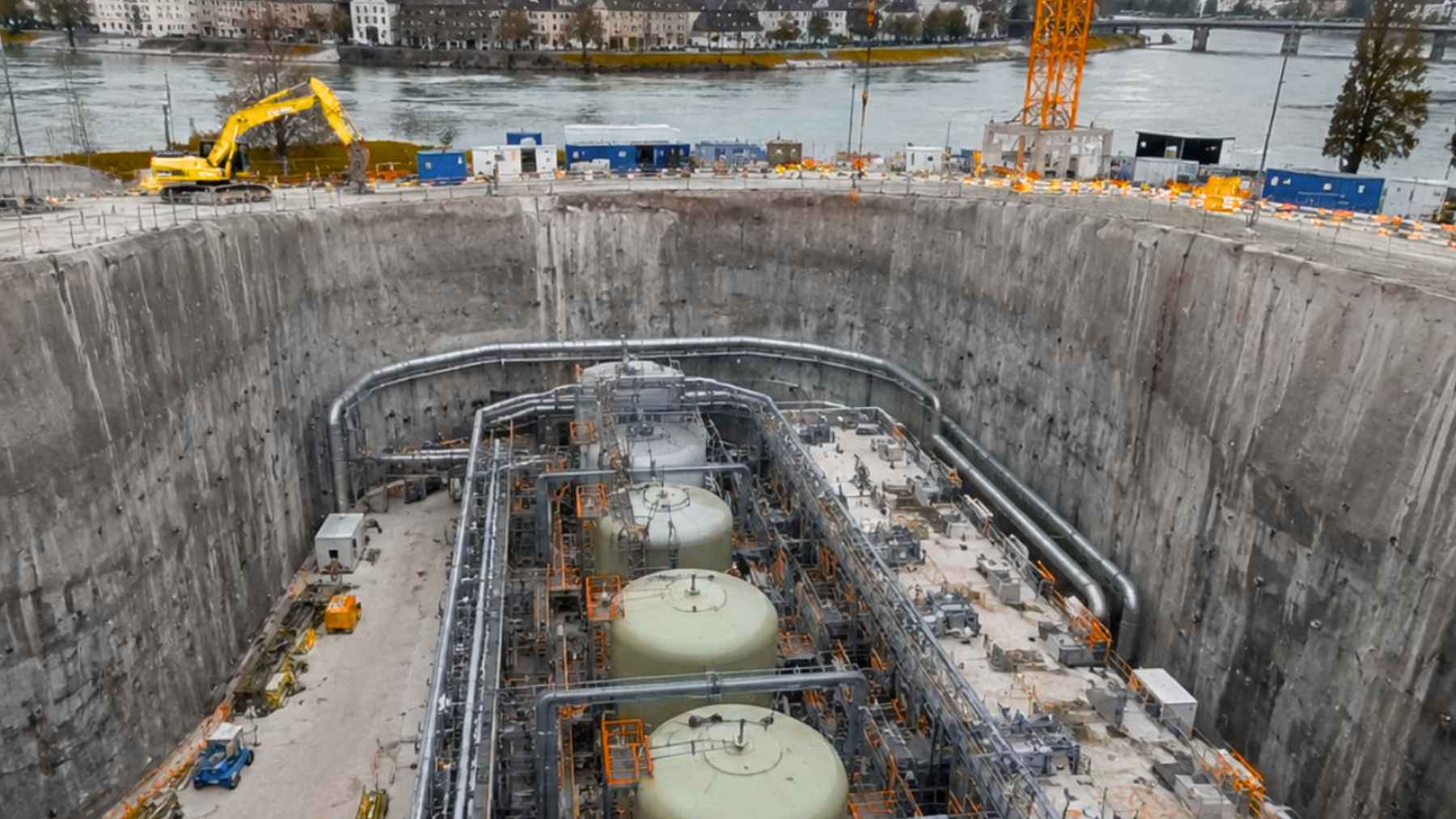
I wanted to research it myself since I didn’t know how Redbox flow batteries operate. It is two giant tanks of liquid energy. When there’s extra electricity from wind or solar, pumps move special vanadium-based liquids through a stack of cells, storing that energy as a chemical change. When electricity is needed later, the process runs in reverse and the liquids generate power for the grid. Unlike lithium batteries, the energy is stored in the liquid tanks, so making the battery bigger is mostly a matter of building larger tanks. The Swiss project will store about 2.1 GWh of energy—enough to help balance renewable power on a massive scale—and was chosen partly because redox-flow batteries are non-flammable, long-lasting, and can be cycled tens of thousands of times with little degradation
The headline looks wrong, but it actually isn’t.
The article specifies:
- Total capacity: 2.1GWh
- Peak output: 1.2GW
- Ramp up time: a few milliseconds
That’s what the “within milliseconds” in the title refers to.
Every power generator has a ramp up time. Think the time it takes to start the engine in a diesel generator, until it spins up and is able to output peak power.
Nuclear reactors can hare ramp-up times of hours, in some conditions even days.
This thing here can go from zero to peak output within almost no time, which makes it perfect to balance the sometimes erratic and unpredictable generation fluctuations of renewable energy production.
For comparison, coal or gas power generators usually have large flywheels that, once spinning, react almost instantly to power fluctuations in the network by converting their motion to electricity or the other way round. If these coal or gas generators aren’t running, they can’t be used to balance the fluctuations in the network, so battery solutions like the one in OP are required to actively manage the network stability.
Thanks, I edited the headline to make it clearer, but this community is overrun with confidently incorrect folks.
…this community - oh, you mean social media! Yes, quite true.
That’s like a huge capacitor on my hobby electronics brain.
That’s pretty much the job, except a billion times as large.
Perfect power source for a Death Star! The planet goes from zero to smithereens in milliseconds!
FYI. Hydro power has similar capacity and start up times
Not quite - only the biggest hydro stations can generate a gigawatt or more, and their startup time is like 10 minutes.
This project is only 500 MW here
And other places say 800 MW
Both of which are comparable to large hydro.
Modern pumped hydro has a ramp up in the 10s of seconds range.
Anyway. Same ballpark in terms of power.
I must have got the 1.2GW from some comment.
It’s in the title so you are not mistaken. The problem is that various statistics have been reported and we don’t know what is correct.
Yeah, the downside of hydro though is that you need to have a fitting space to build it. You can’t just excavate a random field somewhere and plonk a hydro dam right there.
In most places all easy spots for hydro are already taken.
Very true. You can build a pool on top of a mountain and pump/discharge water but it is super expensive for limited capacity.

this will be by far the largest vanadium flow battery in the world, especially outside china


Asked for comments, they kept saying “Rest assured there is no death ray plans”
(/j)
Yeah that’s what the large hadron collider is for, everyone knows that.
Yeah, no, it’s not going to output 1.2 gW in milliseconds.
The headline is most likely a misunderstanding, but “Output X Watt in Y time” isn’t all that wrong, since it would be talking about how quickly the power supply can respond to demand.
Every power supply has a ramp-up time, and the way the headline is worded hints to a very short ramp-up time, which would be very helpful for network stabilization.
But yeah, it’s likely the headline writer just misunderstood something.
How big is a soccer field?
That’d be 691077 regular sized hamburgers laid next to each other in a rigid grid pattern, 797502 if laid in a hexagonal pattern, 891720 if squished.
How many gallons per football field is that?
And when I say football I men real one
Well…How big are regular sized hamburgers?
1/3 to half the size of your appetite.
hmm… that’s more like a variable than a cpnstant
actually, it’s a parameter
fair…
They are not standard sized.
This makes the comparison even more stupid xD
deleted by creator
because we metric users are eeeeevil
Don’t stick your thing in it!!
Remember Wally? Ooof. I mean, kind of a jerk and all but. What a way to go.
Let’s do some math:
2.1GWh
And
Multi billion dollar price (let’s assume 3 billion)
2.1GWh - > 3billion
2.1MWh - > 3 millon
2.1kWh - > 3000 Usd /2.1
1KWh - > ~1430 USD
Considering that 1kWh in lithium ion batteries is like 150 USD they aren’t getting a good value out of it.
I don’t think the multibillion price tag is about the physical battery itself.
It’s probably the cost of the entire project. Which includes:
- Project management
- Engineering
- Digging the whole
- Security
- Maintainance
- Environmental impact analysis (among many other analysis)
- Reducing the environmental impact
- Permits (and a LOT of bureaucracy)
The list goes on. Notice how I didn’t even mention the battery itself.
Not everything scales linearly.
Larger startup cost, but over the one power plant’s lifetime the Li batteries would wear out and have to be replaced many times.
$1 per WH or almost that is pretty terrible. You can get battery systems for 1/4 of that $/WH at Home Depot.
Yeah, I agree that decentralization of the grid and self-consumption is better than these mass baseload solutions…but they will only get cheaper.