…Redwood believes that by 2030, end-of-life batteries could supply more than 50 percent of the entire energy storage market. Instead of grinding up used batteries to reclaim the critical materials inside, put them to work storing electricity. There have been many experiments done that re-purpose used EV batteries which no longer can supply enough power to meet the need for rapid acceleration in an EV but still have up to 80 percent of their original energy storage capacity available…
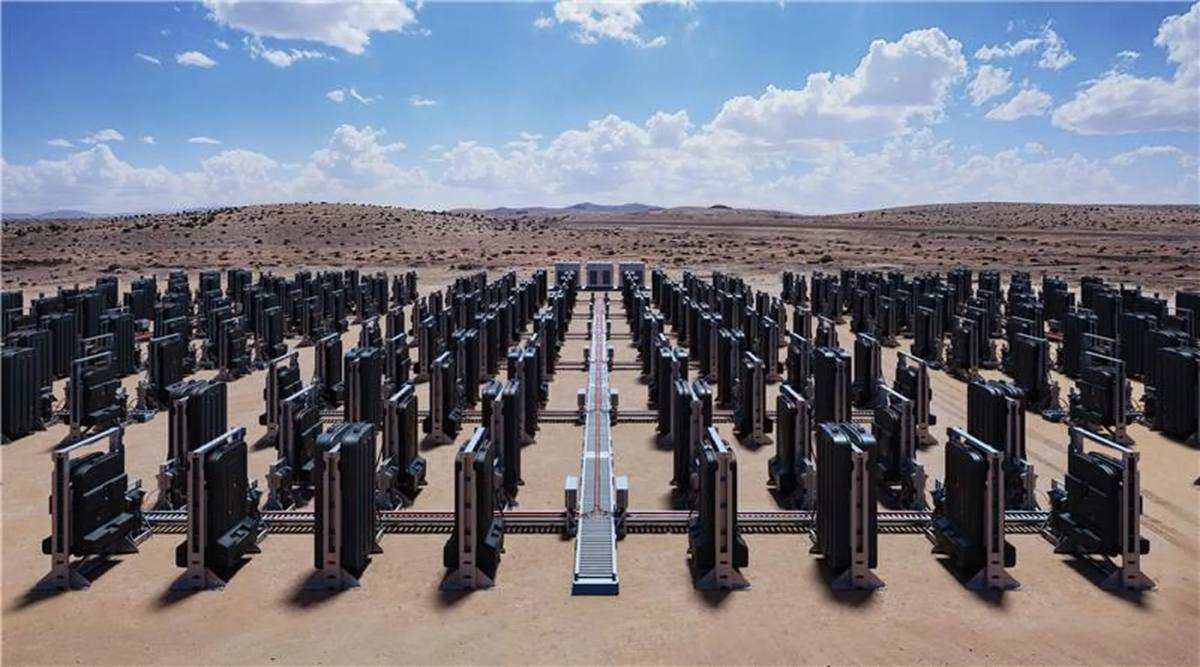
…Traditional energy storage systems are high density and require heavy-duty cooling. To avoid this, Redwood’s team opted for an open-air, low-density system mounted on above-ground cable trays.
Spreading packs out in the open air helps avoid the need for active refrigeration, and stripping away moving parts like fans and filters minimizes potential reliability failures. Keeping the wiring above ground and limiting the size of each modular component minimizes the need for large equipment. As Sun explained, the result is a storage system that is faster to build, easier to inspect after storms, and cheaper to keep running over time…
Nissan proposed to make a street lamp with a used car battery module in the base, so each lamp can hold 10 kWh distributed neatly all around the city
The idea is not bad, but also a testament to the batteries problem. The current technology in them dies too fast if this could be a viable solution.
Nice for the current state of reality, but hopefully batteries are better in the future.
the batteries problem.
It’s different use cases - you can’t handle an EV battery that only lets you accelerate 0-60 in 89 seconds, but that same EV battery can power the street lamp and similar loads for weeks between charges without trouble.
No, it’s also that use case.
80% battery life is still not optimal for any EV with current range.
That’s an illogical and likely outdated perspective on battery capacity. I voluntarily charge my battery to 80%, both to prolong its life and because 80% is more than enough to meet my driving needs with only one charge per week. I also get a faster charge due to the taper of the power curve.
80% for me is 400 km / 248 miles of range, or 57 km / 35 miles per day. My commute to work is twelve miles each way.
If my battery drops to 80% capacity over a decade, it won’t affect me. I’d still have plenty of overhead with 400 km / 248 miles between charges.
What car is that?
Hyundai Ioniq 5
Nice, especially with a solar panel at the top. But street lamps near roads are prone to accidents, and I’m sure a big block of Li-Ion in the base would make these way more risky.
Not having read the article, I wonder if building an elevated array of photovoltaic panels over the batteries would make sense by shading them from the sun, giving more passive help with heat? A simple roof would be cheaper but solar panels would mean the site is also producing electricity, not just storing it.
They should make “grid modules” like that out of shipping containers - racks of batteries inside with solar panels on the roof. Maybe the panels could be on swing-out hinges to make them able to stow away more compactly for transport on top, and then fold out for more surface area after the module is installed on site
They do this for festivals and construction sites and such in conjunction with the typically fossils generators nowadays. Not everywhere but it definitely exists. Exactly like described: Shipping container, batteries and inverter inside, 4 legs, and 2 Shipping container long solar arrays mounted to a frame. Set the container down anchor the legs put the panel frames up connect some wires and your ready to go.
I’m pretty sure you could just buy that too if you wanted a head start on your off grid cabin.
Why does CleanTechnica have a disclaimer saying its articles are for “entertainment only”?
it’s clearly an ad for that redwood company
Spreading packs out in the open air helps avoid the need for active refrigeration, and stripping away moving parts like fans and filters minimizes potential reliability failures.
Hasn’t Ms. Sun ever heard about that other thing that is out in the open? The sun?
Volts had a good podcast about this: https://www.volts.wtf/p/can-second-life-ev-batteries-work
Neat!